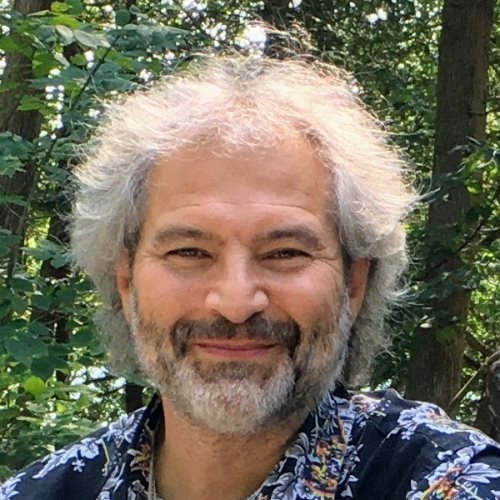
What I do now
Two things, and they feed each other. As a consultant I help small aviation companies answer the security questions that authorities, investors and customers ask: readiness assessments against NIST CSF 2.0, ISO/IEC 27001 or EASA Part-IS; threat models and security requirements that line up with DO-326A/ED-202A for aircraft under certification; incident response plans and tabletop exercises; and role-based training. As a researcher I measure what actually happens to GNSS and ADS-B in the real world, at the scale of hundreds of billions of surveillance messages, and I turn that into exposure analyses for the routes and regions a client flies.
I work alone, on fixed-scope engagements or a part-time retainer, with no junior hand-offs. You get the person whose name is on the papers.
Research
My research asks a plain question: how much can the aviation system trust the position, velocity and identity data it receives from aircraft, and what does it look like when that trust is misplaced? The answers come from measurement rather than from threat catalogues. Across the published work I have analyzed 376.9 billion ADS-B messages from the OpenSky Network, and the 2025 GET-25 benchmark adds another 246.7 billion, covering 77.5 million flight hours across 260 Flight Information Regions.
- ADS-B integrity degradation: anomalies cluster in time, last far longer than tracker tolerances, and recur across days; monitoring needs to become predictive. Reliability Engineering & System Safety, 2026.
- GPS anomalies in aviation: 53,232 GPS gaps and 5.9 million position deviations in 376.9 billion messages, correlated with NOTAMs. Journal of Aerospace Information Systems, 2025.
- GNSS anomalies as a signal of geopolitical instability. Journal of Transportation Security, 2025.
- Unmanned aircraft accidents: NTSB reports classified with a large language model. International Journal of AI for Materials and Design, 2025, with an interactive map.
- Global UAS regulation, with Christian Janke and Jan Uijtdehaag. IEEE ICNS, 2025.
- GET-25: the Global Envelope Thresholding framework and an open benchmark of traffic-normalized kinematic integrity, with Joao S. D. Garcia and Timothy A. Smith, 2026 (under review).
All of it is on the Research page with abstracts, DOIs and full-text PDFs, and the data and code are on the datasets page. My doctoral research at the University of Essex, in Data Science, continues this line: kinematic integrity and security in automated aviation systems.
How I got here
I was born in Minsk and studied at the Faculty of Robots and Robotic Systems of the Belarusian Polytechnic Institute, where I wrote my first commercial software: a payroll system built inside a spreadsheet on a PC without a hard drive. After my family emigrated to Israel I worked in computer support and network security, taught computer network design and security at a college, and completed the Software Practical Engineer program at The Open University, in Hebrew, which I learned from scratch.
In Canada I founded several companies. The one that matters most for this work helped medical-device manufacturers prepare the documentation for Health Canada and FDA approval: years of turning engineering into evidence a regulator will accept. That experience led me into aviation. With Uniqopter I led the concept design of a hybrid eVTOL air ambulance, shaped by interviews with medevac operators across Canada and the United States who all struggled with general-purpose helicopters retrofitted with medical equipment. We finished the conceptual design and put the project on hold until the regulations, infrastructure and battery technology catch up.
Working with aerospace engineers showed me how much aviation-specific knowledge I was missing, so I enrolled at Embry-Riddle Aeronautical University and completed the M.Sc. in Aviation and Aerospace Sustainability with a specialization in Aviation Cybersecurity in March 2024. I founded Mevocopter Aerospace in September 2022 to bring the security, regulatory and aircraft-program experience together for the newest and smallest parts of aviation, the ones that cannot yet afford a security department.
Milestones
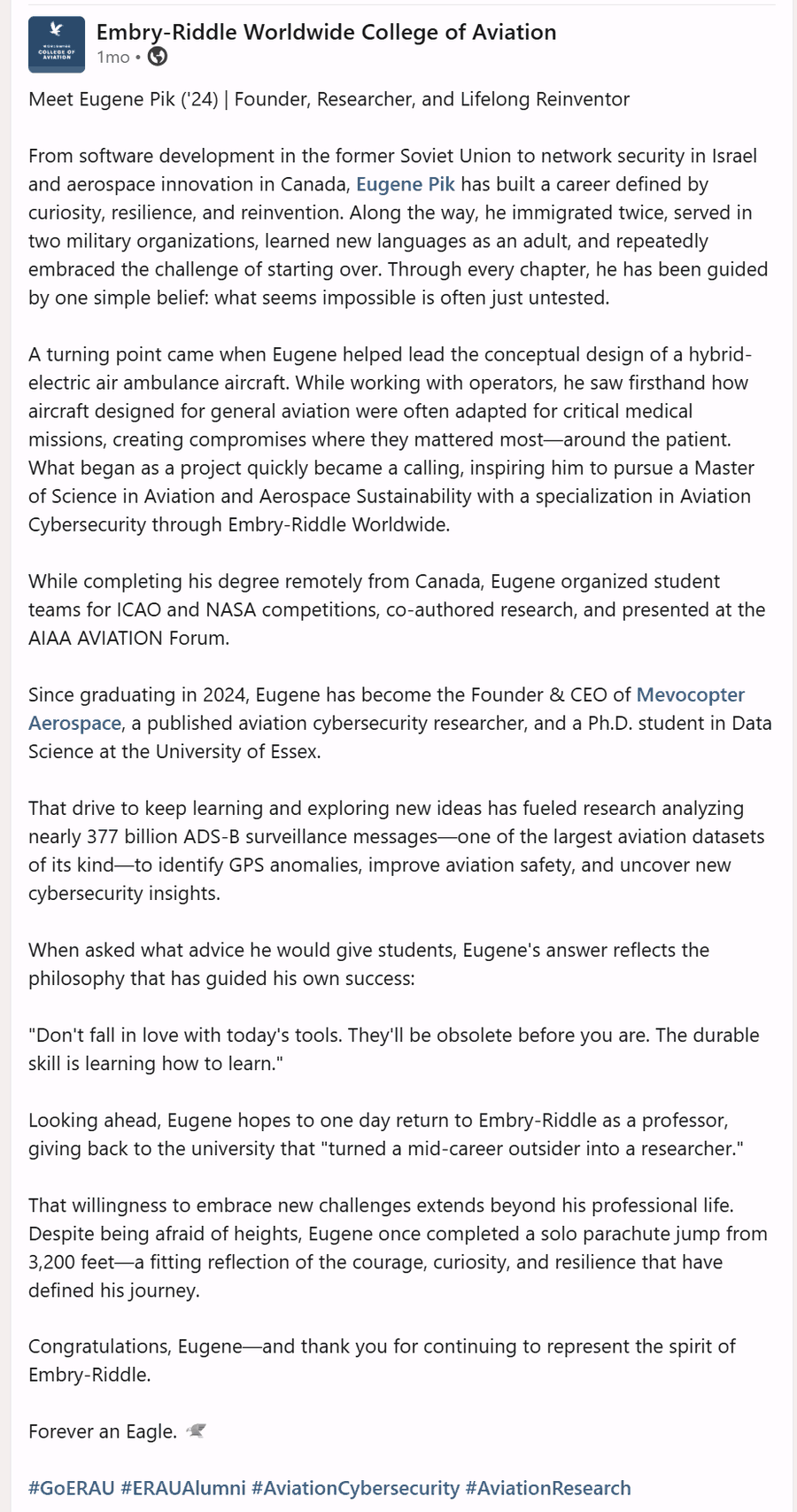
- 2026Reliability Engineering & System Safety paper acceptedSole-author study of ADS-B integrity degradation across 229 billion state vectors. Featured in Embry-Riddle Worldwide's alumni spotlight.
- 2025Three journal papers and a conference paperJAIS, Journal of Transportation Security, IJAMD and IEEE ICNS; GET-25 benchmark released as open data.
- 2024M.Sc., Embry-Riddle; first author at AIAA AVIATION Forum, Las VegasPresented "Detecting GPS anomalies in aviation using ADS-B"; co-author of a propeller mass-sizing paper; research poster at Embry-Riddle Discovery Days; sole-author paper on AI in airport security in the Journal of Transportation Security; organized a team for NASA's 2024 student competition on hurricane forecasting from general-aviation data.
- 2023ICAO student innovation competitionOrganized a team proposing general-aviation aircraft as meteorological sensors through ADS-B Version 3.
- 2022Mevocopter Aerospace foundedFederally incorporated in Ontario, Canada. Sole-author paper on the pilot shortage in the Journal of Air Transport Studies.
- EarlierUniqopter eVTOL air ambulance concept; medical-device regulatory consulting; network security and teaching in Israel; robotics studies in Minsk
Profiles and links
ORCID Google Scholar University of Essex ResearchGate GitHub LinkedIn Embry-Riddle feature story Embry-Riddle alumni spotlight, 2026
Work with me
Consulting starts with a 45-minute readiness call. Research collaboration starts with a message about the question you're working on. Either way, I reply within one business day.
Get in touch