Degradation of Automatic Dependent Surveillance-Broadcast integrity: Temporal clustering and anomaly persistence
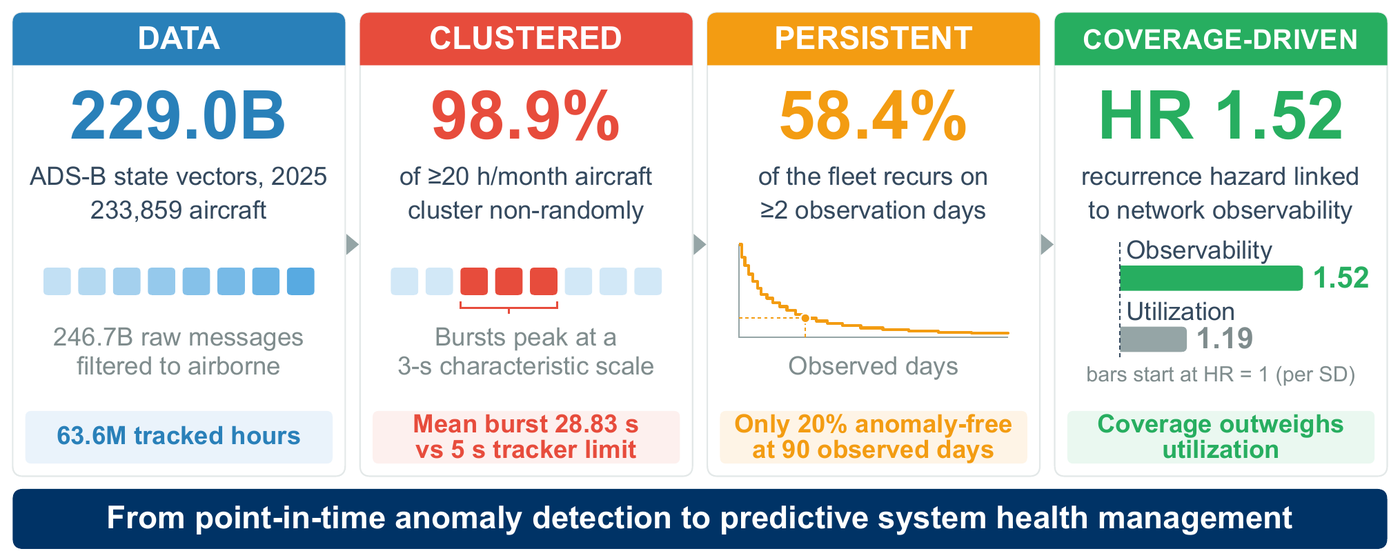
Builds a global baseline of longitudinal ADS-B degradation from 229.0 billion state vectors and shows that kinematic anomalies are not independent random failures: they cluster in time for 98.9% of high-utilization aircraft, peak at a 3-second characteristic scale, and last a mean of 28.83 seconds, beyond the 5-second fault tolerance of decentralized fusion trackers. Recurrence across days is linked more strongly to network observability (hazard ratio 1.52) than to utilization (1.19). The paper argues for moving integrity monitoring from point-in-time anomaly detection to predictive system health management.
Author’s accepted manuscript, shared under CC BY-NC-ND 4.0 in line with Elsevier’s sharing policy. The version of record is at DOI: 10.1016/j.ress.2026.113534.